 Government employees in Pakistan are again waiting for one big update: Salary Increase News Budget 2026-27. Every year before the federal budget, offices, schools, hospitals, departments, and pensioners’ homes start the same discussion: “Is dafa salary kitni barhay gi?” This time the talk is even stronger because reports are mentioning a possible 10% salary increase in Budget 2026-27, new Revised Pay Scales 2026, higher conveyance allowance, tax relief, and pension increase.
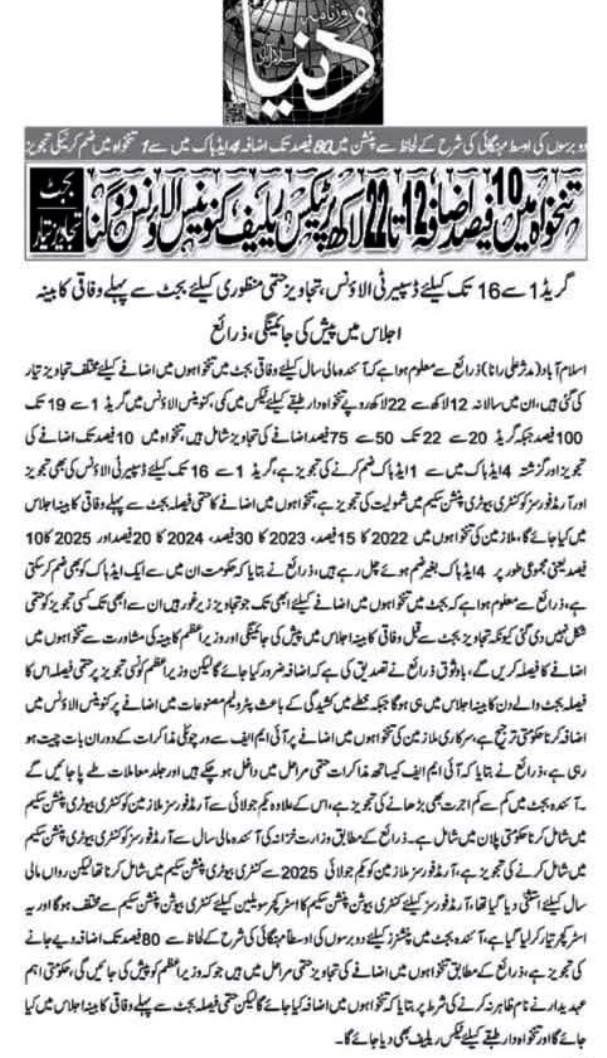
According to the GLXSpace post based on Daily Dunya dated 27 May 2026, the proposals include a 10% salary increase for government employees, merging of ad-hoc relief allowances from 2022 to 2025 into basic pay, possible Revised Pay Scales 2026, 100% increase in conveyance allowance, and pension increase up to 80%, but all this depends on approval after IMF-related discussions.
Here’s what matters: this is still a proposal, not a final notification. Many employees read one headline and think “salary confirm ho gai.” No, bhai, abhi final approval baqi hai. The final decision usually comes with the federal budget speech, cabinet approval, and official notification. The Nation also reported on 27 May 2026 that the government is reviewing proposals for salaries and pensions, with final decisions expected after consultation with the federal cabinet and the IMF.
Salary Increase News Budget 2026-27 Latest Proposal
The main proposal in the current Salary Increase News Budget 2026-27 is a possible 10% increase in salary for government employees. In simple words, if this proposal is approved, employees may get a salary increase calculated on their basic pay. But the bigger point is not only 10%. The real discussion is about whether the government will introduce Revised Pay Scales 2026 by merging previous ad-hoc relief allowances into basic pay.
For many employees, revised pay scales matter more than a simple ad-hoc allowance. Why? Because when ad-hoc allowances are merged into basic pay, it can affect other linked benefits in future. A normal ad-hoc allowance gives relief, but it often stays separate. Basic pay revision can create a better base for future increments, allowances, and pension calculations, depending on government rules.
As per the GLXSpace report, the proposal mentions merging ad-hoc relief allowances for 2022, 2023, 2024, and 2025 into basic pay. This would lead to the introduction of Revised Pay Scales 2026 instead of continuing only with Revised Basic Pay Scales 2022.
But one thing should be clear. Until the Ministry of Finance, federal cabinet, or official budget documents confirm it, employees should treat this as budget news, not a final order.
Quick View of Main Budget Proposals
| Proposal | What It Means for Employees | Current Status |
|---|---|---|
| 10% salary increase | Possible increase on basic pay | Under discussion |
| Revised Pay Scales 2026 | Ad-hoc allowances may merge into basic pay | Proposed |
| Conveyance Allowance increase 2026 | Possible 100% increase for many employees | Proposed |
| Pension increase Budget 2026-27 | Pension may increase up to 80% | Under review |
| Tax relief | Relief for salaried people earning Rs100,000 to Rs200,000 monthly | Proposed |
| Disparity allowance | Possible relief for BPS-01 to BPS-16 | Under discussion |
Government Employees Salary Increase 2026-27
The phrase Government employees salary increase 2026-27 is trending because employees are facing daily expenses from every side. Petrol, rent, school fees, electricity bills, kitchen items, transport, medicines, and children’s education are not small matters anymore. A clerk in BPS-11, a teacher in BPS-16, a nurse, a constable, a junior technician, or a retired pensioner all feel this pressure in real life.
A 10% increase sounds helpful, but employees will ask a fair question: 10% on what? If it is only on old basic pay, the relief may feel small. If it comes after revised pay scales, the impact can become better. This is why employees are watching the Revised Pay Scales 2026 proposal very closely.
The Nation reported that authorities are considering around a 10% salary increase for government employees in the next fiscal year, along with a proposal to include one ad-hoc allowance from 2022 to 2025 into the basic pay structure.
For a simple example, let’s say an employee has basic pay of Rs50,000. A 10% increase means Rs5,000 before deductions and tax impact. But if pay scales are revised and some allowances merge into basic pay first, the salary calculation may look different. That is why many employees are not only asking “10% mile ga?” They are asking, “Revised pay scales bhi aain ge ya nahi?”
Revised Pay Scales 2026
Revised Pay Scales 2026 can become the most important part of this budget package if approved. In Pakistan, government pay scales are revised after some years. The last major federal basic pay scale revision was linked with 2022 scales, and after that employees received different ad-hoc relief allowances.
When ad-hoc relief allowances continue for years, salary slips become complicated. Employees see basic pay separately and ad-hoc allowances separately. Many people want these allowances merged because it makes the pay structure cleaner and may help in future calculations.
The GLXSpace post says the latest proposal includes merging ad-hoc relief allowances of 2022, 2023, 2024, and 2025 into basic pay. It also says that if the government grants 10% Adhoc Relief Allowance 2026 on Pay Scales 2026, it will be better for employees, but if it is given on 2022 pay scales, the relief may not be strong enough.
This point is very important for teachers, clerks, police employees, health staff, junior officers, and other public servants. A revised scale is not just a headline. It changes the base number from where many future things start.
10% Salary Increase in Budget 2026-27
The 10% salary increase in Budget 2026-27 proposal is the most searched part of this news. Employees want a straight answer: “Salary 10 percent barhay gi ya nahi?” The honest answer is: reports say it is under consideration, but final approval is not yet official.
CSSPrep reported earlier in May 2026 that the Finance Ministry had not made an official salary announcement as of 12 May 2026, and several reports at that time suggested tax relief may be preferred instead of a direct salary increase. Later, fresh reports on 27 May 2026 mentioned new proposals for around 10% salary increase, pension increase, and allowance changes.
So, what should an employee understand? Budget talks change quickly. One week, reports may say salary freeze is possible. Another week, reports may say 10% increase is under discussion. That is normal before the budget. Final clarity comes only when the finance minister presents the budget and official notifications are issued.
For now, employees should keep this point in mind: the 10% figure is a strong proposal in media reports, but not a final approved package yet.
Conveyance Allowance Increase 2026
The Conveyance Allowance increase 2026 proposal is also important because transport costs have become a headache. Many employees travel daily from villages to cities, from one tehsil to another, or from rented houses to offices. Petrol prices, bus fares, rickshaw fares, and bike maintenance have all affected monthly budgets.
The GLXSpace report mentions a proposal to increase conveyance allowance by 100% due to petrol price increases. It also says there is a proposal of 50% to 75% increase in conveyance allowance for BPS-20 to BPS-22. The Nation also reported that authorities are considering doubling conveyance allowance for employees from grades 1 to 19, while 50% to 75% increases are being considered for officers in grades 20 to 22.
For lower and middle-grade employees, this can be a useful relief. Think about a government teacher who travels 20 to 30 km daily on a motorcycle. Or a health worker who uses public transport. Even a 100% increase may not fully cover current travel expenses, but it can still reduce some pressure.
GLXSpace also made a fair point that conveyance expenses have increased much more than 100% in real life, so some employees may still feel the proposed increase is not enough.
Pension Increase Budget 2026-27
The Pension increase Budget 2026-27 proposal is very sensitive because pensioners usually have fixed income and rising medical expenses. Many retired employees support families even after retirement. Some pay house rent, some support grandchildren’s education, and many spend a large part of their pension on medicines.
Reports mention a possible pension increase of up to 80% due to average dearness over the last two years. The Nation also reported that officials are reviewing a proposal to increase pensions by up to 80% in line with average inflation over the past two years.
Now this sounds very big, so readers should be careful. “Up to 80%” does not always mean every pensioner will automatically get 80%. It may depend on category, formula, budget room, cabinet approval, IMF discussion, and final government policy. Sometimes media reports mention maximum proposal values, but the final approved increase is lower.
Still, pensioners are right to follow this update closely. If any strong pension relief is approved, it can make a real difference for retired teachers, army-related civilian staff, clerks, railway pensioners, health workers, and other retired public servants.
Tax Relief for Salaried Class
Another part of the Salary Increase News Budget 2026-27 is possible tax relief. According to the GLXSpace post, there is a proposal for tax relief for employees getting Rs100,000 to Rs200,000 monthly salary, and tax reduction for people earning annual salary from Rs1.2 million to Rs2.2 million.
The Nation also reported that the government is examining relief measures for salaried individuals earning between Rs100,000 and Rs200,000 per month, along with possible income tax reductions for salaried people earning Rs1.2 million to Rs2.2 million annually.
This is important because salary increase and tax relief are connected. Sometimes an employee gets a salary raise, but tax deduction also increases. In the end, the take-home salary does not improve much. This is why many salaried people say, “Sirf gross salary nahi, net salary bhi dekhein.”
If tax relief is approved along with salary increase, employees may feel better relief in hand. But if salary increase is small and taxes remain high, the monthly benefit may feel weak.
Disparity Reduction Allowance for BPS-01 to BPS-16
Another proposal mentioned in the GLXSpace post is Disparity Reduction Allowance for BPS-01 to BPS-16. This matters for lower-scale employees because their salaries are often under more pressure compared with actual living costs.
BPS-01 to BPS-16 employees include peons, drivers, clerks, junior technicians, lab attendants, school staff, constables, lower admin staff, and many other workers who keep offices running. These employees are the backbone of public departments. But when inflation rises, they usually feel the strongest pain because their salaries are already limited.
If disparity allowance is approved, it may help reduce the gap between different employee groups. But again, this is still in proposal form. The final budget notification will decide who gets it, how much they get, and whether it applies federally or also inspires provincial governments.
IMF Approval and Budget Pressure
Many employees ask, “IMF ka salary se kya lena dena?” In simple words, Pakistan’s budget is connected with loans, spending limits, tax collection, and fiscal targets. When the government wants to increase salaries, pensions, and allowances, it increases current expenditure. The IMF usually looks at whether Pakistan can afford these increases while meeting revenue and deficit targets.
GLXSpace clearly says the proposals depend on IMF approval, and negotiations are under progress. The Nation also reported that final decisions are expected after consultations with the federal cabinet and IMF, and that discussions with the IMF regarding salary adjustments and tax relief are continuing.
This is why budget news can change until the last days. One proposal may be prepared by government teams. Another may be discussed with the IMF. Then cabinet reviews it. After that, the budget speech gives the public version. Later, finance division notifications give the practical details.
So, employees should follow updates, but they should not make financial decisions only on leaked reports.
What Employees Should Check Before Believing Any Salary News
Before sharing any WhatsApp message or YouTube thumbnail, check these points:
- Is the update from an official notification, budget speech, or only a media report?
- Does it mention federal employees only or provincial employees also?
- Is the increase on basic pay, revised basic pay, or gross salary?
- Are pensioners included clearly?
- Is the news confirmed by Ministry of Finance, cabinet, or official budget document?
This small checking habit can save you from confusion. Many fake salary charts circulate before the budget. Some people add random pay scales, fake percentages, or old notifications with new dates. Always check the date and source.
Federal and Provincial Employees
One more thing. Federal budget decisions do not always automatically apply to all provincial employees in the same way. Provinces like Punjab, Sindh, KPK, and Balochistan usually announce their own budget decisions. Sometimes they follow the federal pattern. Sometimes they give different percentages or allowances.
So if the federal government announces a 10% salary increase, provincial employees should wait for their provincial budget and finance department notification. For example, a Punjab school teacher, Sindh health employee, KPK clerk, or Balochistan police staff should check the relevant provincial finance department update after the provincial budget.
Federal employees may get one notification. Provincial employees may get separate notifications. Pension rules can also have separate instructions depending on department and government level.
Expected Impact on Monthly Salary
Let’s keep it simple. If a 10% salary increase is approved on basic pay, the direct increase depends on your basic pay. A person with Rs35,000 basic pay may see a different increase than someone with Rs80,000 basic pay. If revised pay scales are introduced first, the calculation may change. If tax relief is also approved, the net take-home salary may improve further.
For pensioners, the formula will matter even more. If pension increase is approved up to a certain percentage, it may be linked with existing gross pension, net pension, age category, or government formula. Nobody should assume the exact amount until the official notification is issued.
For conveyance allowance, the impact can be easier to understand if the government doubles existing rates. But even then, grades and categories may matter.
Why Revised Pay Scales Matter More Than Only 10%
Many employees are emotionally focused on the 10% figure, but senior employees know that revised pay scales can be the bigger story. If old ad-hoc allowances are merged into basic pay, it can clean the salary structure and possibly support future increments.
For example, if a person gets ad-hoc relief separately, it helps monthly income. But if that amount becomes part of basic pay, future calculations may become stronger depending on policy. That is why employee unions often demand merging of ad-hoc relief allowances instead of only giving another temporary allowance.
The GLXSpace analysis also says the package would be better if the 10% increase comes on Pay Scales 2026 rather than old 2022 pay scales. This is a practical point, not just a technical one.
What May Happen Next
The next step is budget approval. Reports can guide us, but final decisions will come through the federal budget process. According to The Nation, all salary and pension proposals are expected to be presented before Prime Minister Shehbaz Sharif and the federal cabinet for final approval.
Employees should watch for three things. First, the budget speech. Second, Finance Division notifications. Third, department-level instructions for salary disbursement. Sometimes the budget speech gives the percentage, but the notification explains the real formula.
If Revised Pay Scales 2026 are approved, employees will need the full pay scale chart. If conveyance allowance is increased, employees will need grade-wise rates. If pension is increased, pensioners will need the official pension notification.
Salary Increase News Budget 2026-27 for Real Pakistani Families
For many families, this update is not just office talk. It affects school fees, house rent, monthly ration, bike petrol, electricity bill, medical bills, and Eid shopping. A small increase can also help people repay loans or manage committee payments. That is why government employees and pensioners follow budget news with so much interest.
At the same time, we should stay honest. The Salary Increase News Budget 2026-27 report is positive for employees, but it is still not final. The strongest proposals right now include Government employees salary increase 2026-27, Revised Pay Scales 2026, 10% salary increase in Budget 2026-27, Conveyance Allowance increase 2026, and Pension increase Budget 2026-27. If approved, this package can bring relief. If changed, employees may get a smaller package or tax relief instead. Keep checking official updates, and do not trust every viral screenshot.


I am Fahad Munir, an experienced finance and prize bond analyst, provides reliable, up-to-date results, expert tips, and insights at BondResult.com to enhance your prize bond strategies