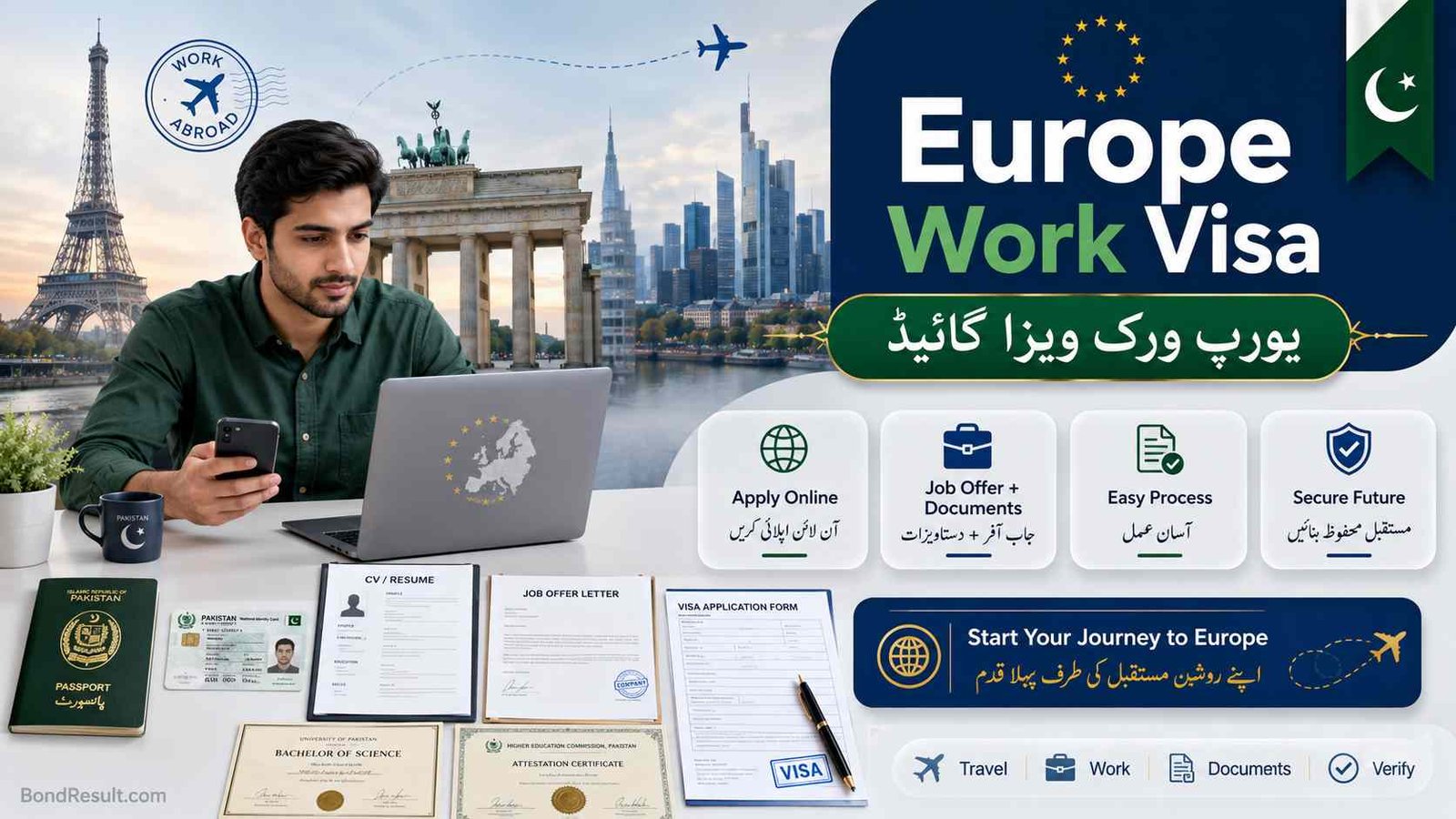
 Many Pakistani job seekers dream of working in Europe. Some want better salary, some want a safe future for family, and many young boys from Lahore, Faisalabad, Gujranwala, Multan, Karachi, Peshawar, and small towns simply want one honest chance. But Europe Work Visa ka scene thora confusing hota hai. Every country has its own rule, own appointment system, own fee, and own document list.
Here’s what matters first. There is no single Europe Work Visa for all countries. Europe has many countries, and each country gives its own work visa or residence permit. Germany has skilled worker visa and EU Blue Card. Italy has work visa under employer approval and quota systems. Poland has D-Type national visa for work. Portugal’s old job seeker route has changed, and the official Portuguese visa page currently says the skilled job seeker visa is not yet available at Portuguese consular offices.
So, if someone says, pay me money and I will give you direct Europe free visa, be careful. Real work visa mostly starts with a real employer, legal contract, embassy appointment, proper documents, and official fee.
What Is a Europe Work Visa?
A Europe Work Visa is permission to enter a European country for legal work. For Pakistani citizens, this is usually a national visa, long-stay visa, residence visa, work permit, or EU Blue Card, depending on the country. A normal Schengen visit visa is not a work visa. You cannot go on a tourist visa and start working legally. Ye baat bohat important hai, because many agents confuse people with visit visa and work visa.
For example, Poland says its Schengen C-Type visa is for stays up to 90 days in any 180-day period, while its National D-Type visa is for stays longer than 90 days. For work, most Pakistani applicants need a national visa after getting a work permit, job offer, or employer approval. Italy also says non-EU citizens who want to work in Italy must apply for a work visa, and after reaching Italy they convert it into a residence permit for work purposes.
In simple words, Europe Work Visa means you are going with legal permission to work, not just visit.
Europe Work Visa for Pakistani Applicants
For Pakistanis, the common Europe work visa routes are Germany, Italy, Poland, Romania, Hungary, Croatia, Lithuania, Portugal, Spain, France, Netherlands, and Sweden. But not every country is equally easy. Some countries need high salary, strong degree, language skills, or employer sponsorship. Some countries have seasonal jobs in agriculture, hotels, construction, warehouse, driving, factory work, and care work.
Germany is strong for skilled workers, IT, engineers, nurses, healthcare, vocational workers, and qualified professionals. German Missions in Pakistan list online categories such as EU Blue Card, skilled workers with academic background, skilled workers with vocational education, skilled workers with practical experience, vocational training, recognition measures, and Opportunity Card.
Poland usually needs an original work permit and a printed signed visa form on appointment day. The Polish official page also warns applicants not to use fake appointment websites and says e-Konsulat is the only official online registration system for Polish consulates worldwide.
Italy mostly depends on employer approval and quota system. For salaried work, Italy requires a nulla osta, which is a no-impediment approval issued in Italy before visa application.
Europe Work Visa Apply Online
You can start many Europe work visa steps online, but almost always you still need biometrics, appointment, original documents, and passport submission. So when people search europe work visa apply online, they should understand the full process.
For Germany from Pakistan, some categories can apply through the German Consular Services Portal, including EU Blue Card, skilled workers with university background, vocational qualification, practical experience, Opportunity Card, and vocational training. This is useful for Pakistani applicants because Germany is moving many skilled categories toward online document upload before final embassy handling.
For Poland, online registration is done through e-Konsulat, but the applicant must still come to the consular office with printed form, original work permit, and required documents.
For the EU Blue Card, the European Commission says the applicant or employer must submit the application to the competent national authority in the country where the person wants to work. Rules and fees can change by country.
Europe Work Visa Requirements
Most Europe Work Visa requirements are similar, but each embassy can ask for extra papers. Generally, Pakistani applicants should prepare these documents before paying any agent or applying online.
| Requirement | Simple Explanation |
|---|---|
| Valid passport | Usually valid for at least several months beyond travel |
| Job offer or contract | Most work visas need a real employer offer |
| Work permit or approval | Some countries need employer approval first |
| CV | Updated CV in European style |
| Educational documents | Degree, diploma, certificates, transcripts |
| Experience letters | Very important for skilled and technical jobs |
| Police character certificate | Often required for long-stay visas |
| Medical or insurance | Depends on country and visa type |
| Proof of accommodation | Sometimes employer provides it |
| Visa application form | Filled online or printed |
| Appointment and biometrics | Usually required at embassy or visa center |
| Visa fee | Paid in local currency or as embassy instructs |
Germany’s EU Blue Card needs a specific job offer, a contract period of at least six months, and a job that matches qualification. Germany’s official Make it in Germany page lists 2026 salary thresholds of €50,700 gross annual salary for regular EU Blue Card and €45,934.20 for shortage occupations or young professionals, subject to conditions.
For the wider EU Blue Card, the European Commission says applicants need a valid work contract or binding job offer for highly qualified employment for at least six months, qualification documents, valid travel document, and sickness insurance evidence where required.
Europe Work Visa Price
Europe work visa price is not the same for every country. Also, visa fee is only one part. Pakistani applicants also spend money on passport, photos, document attestation, courier, translation, police certificate, medical, travel insurance, appointment service charges, and sometimes ticket and accommodation.
A safe way to understand cost is this:
| Cost Type | Expected Situation |
|---|---|
| Embassy visa fee | Depends on country and visa type |
| Service center fee | If VFS/BLS or other center is used |
| Document translation | Needed for some countries |
| Attestation | HEC, IBCC, MOFA, or foreign office type needs |
| Police certificate | Required in many long-stay cases |
| Medical/travel insurance | Depends on country |
| Ticket and settlement money | Needed after visa approval |
| Agent fee | Avoid unless licensed and transparent |
For France from Pakistan, the official France visa page says the applicant pays a visa processing fee before interview and biometrics, and the fee is collected only in Pakistani rupees at the current chancellery rate. It also says the fee is non-refundable if the visa is rejected.
For EU Blue Card, the European Commission says the applicant or employer may have to pay an application fee depending on the member state. So never trust one fixed Europe work visa price in Pakistan. Always check the country’s official embassy page before payment.
Europe Work Visa Price in Pakistan
Many Pakistani applicants ask, Europe Work Visa price in Pakistan kitni hai? The honest answer is: it depends on country, category, exchange rate, and document condition. A Germany skilled worker visa cost will not be exactly the same as Poland D visa, Italy work visa, France work visa, or Spain residence work visa.
Also remember, the biggest risk is agent fraud. Some people pay Rs. 5 lakh, Rs. 8 lakh, even more, without checking if the employer is real. Later they find the work permit is fake, appointment is fake, or company does not exist. Poland’s official page clearly warns applicants to be cautious with companies claiming to offer help and charging money for visa procedure.
A good rule: first check official embassy source, then verify employer, then verify work permit, then pay only documented and legal fees. Paise dene se pehle proof lein. WhatsApp screenshot is not proof.
Europe Work Visa Apply Online Free
People search europe work visa apply online free because they want to avoid agents. That is smart, but let’s keep it realistic. You may apply or register online yourself for many countries, but visa fees are usually not free. Online form filling may be free, official registration may be free, but embassy fee, service fee, document cost, and travel cost are separate.
For example, Poland says e-Konsulat is the only official online registration system for Polish consulates worldwide. That means appointment registration should be through the official system, not random websites. Germany also lists online application categories through its Consular Services Portal for Pakistan.
So yes, you can start online yourself in many cases. But no, a complete legal Europe work visa is usually not free.
Which Country Is Easy to Get Work Visa in Europe?
This is the question every Pakistani asks: which country is easy to get work visa in Europe? The answer depends on your profile.
If you are skilled, educated, and have experience, Germany can be a strong option. If you have a proper employer and work permit, Poland can be possible. If you have an Italian employer under quota route, Italy can work. If you are highly qualified, EU Blue Card countries can be good, but salary and qualification rules are strict.
Here is a simple comparison:
| Country | Easier For | Main Challenge |
|---|---|---|
| Germany | Skilled workers, IT, nurses, engineers, vocational workers | Qualification recognition, salary, German language for some fields |
| Poland | Factory, warehouse, skilled labor with work permit | Appointment availability and genuine work permit |
| Italy | Seasonal/work quota jobs | Employer approval and quota timing |
| Portugal | Skilled route may change | Official job seeker visa currently not available |
| Spain | Employer-based work route | Employer approval and work authorization |
| France | Skilled and employer-sponsored work | Strong documentation and employer process |
| Sweden/Netherlands | Highly skilled workers | Salary and employer standards |
For highly qualified workers, the EU Blue Card applies in 25 of 27 EU member states and does not apply in Denmark and Ireland. The European Commission says it is for highly qualified non-EU workers with qualifications or professional skills, employment contract or binding job offer, and salary conditions.
Europe Work Visa Without Job Offer
Can you get a Europe Work Visa without job offer? Sometimes yes, but options are limited and rules change quickly.
Germany has Opportunity Card and job search related routes for eligible applicants. German Missions in Pakistan list Opportunity Cards among categories available through the online portal. But this does not mean everyone can simply apply without skill, education, or funds. You still need eligibility.
Portugal was popular for job seeker visa, but the official Portuguese Ministry page currently says the Skilled Job Seeker Visa is not yet available at Portuguese consular offices and is waiting for regulation under Article 57-A. So do not rely on old YouTube videos saying Portugal job seeker visa is open, unless the official page confirms it again.
For most European countries, a job offer is still the main door.
How to Get a Work Visa from Europe?
To get a work visa from Europe, follow a clean and legal process. Don’t rush. Europe visa file is not like sending one CV and getting stamp next week. You need patience.
First, choose country according to your profile. If you are a nurse, Germany may be better. If you are a driver or factory worker, Poland, Hungary, Croatia, Romania, or Italy-type routes may appear in market, but you must verify employer. If you are IT or engineer, Germany EU Blue Card or skilled worker route can be strong.
Second, prepare your CV, passport, education papers, experience letters, and police certificate. Third, apply for jobs on official company websites, trusted job portals, and legal recruiters. Fourth, after getting offer, employer may apply for work permit or approval. Fifth, you book embassy or official visa appointment. Sixth, submit file, give biometrics, and wait for decision.
The EU Blue Card decision should be given as soon as possible and no later than 90 days after complete application submission, according to the European Commission. Country-level work visas may take more or less time.
How to Apply for Work in Europe?
You can apply for work in Europe from Pakistan by using a proper job search strategy. Don’t only write “sir job chahiye” in Facebook groups. Make a real CV. Mention your trade, experience, certificates, driving license category, language level, and passport details if needed.
For skilled jobs, LinkedIn, EURES, official employer websites, hospital career pages, hotel chains, construction companies, and recruitment agencies are better than random WhatsApp groups. For Germany, Make it in Germany is a useful official information platform. For Poland, employer work permit is important before D-type visa appointment. For Italy, the employer-side approval called nulla osta matters for salaried work.
A small tip from local experience: make one folder on mobile and laptop. Keep scanned passport, CNIC, CV, photo, degree, diploma, experience letter, police certificate, and English translations. When job comes, you can apply quickly. Warna last date guzar jati hai, phir banda kehta hai kismat kharab thi.
How to Apply for a Germany Work Visa from Pakistan?
Germany is one of the most searched routes for Pakistanis because it has skilled worker options, EU Blue Card, vocational routes, Opportunity Card, and shortage occupation demand.
The basic Germany work visa process from Pakistan is:
- Check your category: EU Blue Card, skilled worker with degree, skilled worker with vocational qualification, practical experience, Opportunity Card, vocational training, or recognition route.
- Prepare documents according to German mission checklist.
- For eligible categories, apply online through the German Consular Services Portal.
- Upload documents and complete online steps.
- Book or receive appointment instructions as per category.
- Attend appointment with original documents.
- Submit biometrics and passport.
- Wait for decision.
German Missions in Pakistan list multiple work categories that can apply through the online service portal, including EU Blue Card, skilled workers with academic background, vocational education, practical experience, and Opportunity Cards.
For Germany EU Blue Card, your job offer must normally be at least six months, match your qualification, and meet the salary threshold. As of 2026, Make it in Germany lists €50,700 gross annual salary for regular Blue Card and €45,934.20 for shortage occupations or young professionals under conditions.
Best Europe Work Visa Route for Different Pakistanis
For a Pakistani nurse, Germany can be good, but language and recognition matter. For an IT worker, Germany EU Blue Card or skilled worker route can be strong, especially if salary meets threshold. For factory workers, Poland, Italy, Romania, Hungary, Lithuania, and Croatia may be searched more, but the key is genuine employer and legal work permit. For students who recently completed degree, Germany Opportunity Card or skilled route may be worth checking. For people without skill, Europe visa becomes difficult because legal employers need proof that you can do the job.
A Pakistani applicant should not choose country only because someone says “easy visa.” Choose country by your skill, documents, job market, language, and total cost. Easy for one person can be impossible for another.
Common Mistakes Pakistani Applicants Make
Many people lose money because they make simple mistakes. They trust an agent without license. They accept a fake offer letter. They apply for visit visa and plan to work illegally. They submit weak bank statement. They hide refusal history. They use fake experience letters. They don’t check official embassy pages. They don’t understand that work permit and visa are two different steps in many countries.
One more common mistake is applying for the wrong visa type. If you want to work more than 90 days in Poland, the official page says D-Type national visa is for stay longer than 90 days, while Schengen C-Type is for short stay. This small difference can decide your whole file.
Europe Work Visa Checklist for Pakistanis
Before applying, check these points:
- Your passport is valid and has blank pages.
- Your job offer is real and signed.
- Employer exists and can be verified.
- Work permit or approval is genuine.
- Your documents match your job.
- You have no fake paper in file.
- You checked the official embassy website.
- You know the real visa fee and service fee.
- You can explain your job clearly in interview.
- You have copies and scans of all documents.
“Always check work visa information from official embassy, government, or recognized visa portal. Agent ki baat tab tak final na samjhein jab tak official source confirm na kare.”
FAQs About Europe Work Visa
How to get a work visa from Europe?
Choose a country, find a genuine employer, get job offer or work permit, prepare documents, book official visa appointment, submit biometrics, and wait for decision. Some skilled routes, like Germany, also allow online document submission for selected categories.
What is the easiest country in Europe to get a work visa?
There is no one easiest country for everyone. Germany may be easier for skilled workers and IT professionals. Poland may be possible for applicants with genuine work permits. Italy depends on quota and employer approval. Your skill and documents matter more than country name.
How to apply for work in Europe?
Prepare a professional CV, apply on official company websites and trusted job portals, contact legal recruiters, verify employer, and only then start visa process. Avoid WhatsApp-only job offers.
How to apply for a Germany work visa from Pakistan?
Check your German visa category, prepare documents, use the German Consular Services Portal for eligible categories, upload documents, follow appointment instructions, and submit your original file at the required stage. Germany lists EU Blue Card, skilled worker, vocational, practical experience, and Opportunity Card categories for Pakistan applicants.
Can I apply for Europe Work Visa online free?
You can fill many forms or register online yourself, but visa is usually not fully free. Embassy fee, service charges, documents, travel insurance, translation, and attestation may cost money.
Can I get Europe Work Visa without job offer?
Some routes may allow job search, such as Germany Opportunity Card for eligible applicants. But most Europe work visas need a job offer, employer approval, or work permit. Portugal’s skilled job seeker visa page currently says it is not yet available at Portuguese consular offices.
Best Advice Before You Apply for Europe Work Visa
Europe Work Visa can change your life, but only if you apply safely. Don’t run after shortcuts. If you are from Pakistan and planning to apply, first make your documents strong, then choose the right country, then search for real job. Germany is strong for skilled people. Poland and Italy can work if employer documents are genuine. EU Blue Card is good for highly qualified workers, but salary and qualification rules are strict.
For BondResult readers, my simple advice is this: never pay big money only on promises. Check official sources, keep your documents clean, and apply with patience. Europe Work Visa is not impossible, but it needs proper planning, real job, and honest paperwork.


I am Fahad Munir, an experienced finance and prize bond analyst, provides reliable, up-to-date results, expert tips, and insights at BondResult.com to enhance your prize bond strategies